
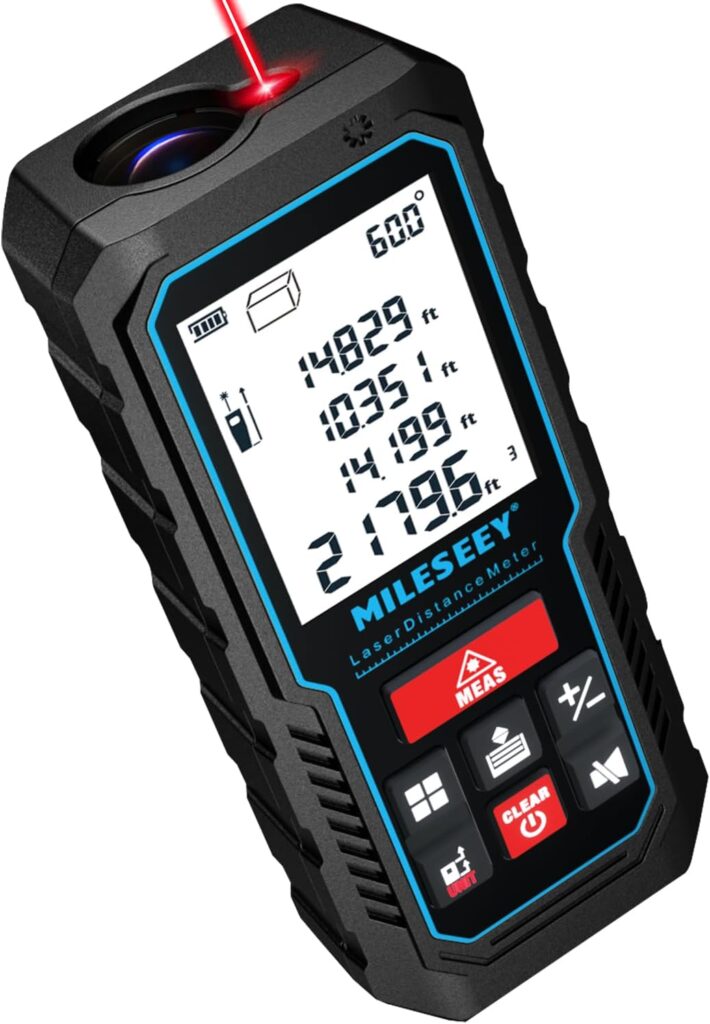


MILESEEY Laser Measure with Angle Sensor: A Practical Review
Measuring distances accurately is one of those tasks that seems simple until you actually have to do it. Tape measures work well enough for short spans, but once you are dealing with long rooms, high ceilings, or awkward spaces where a tape cannot reach, the process becomes slow and often unreliable. The MILESEEY Laser Measure, model D5, is a handheld laser measuring tool designed to address exactly that problem. It combines a laser distance sensor with an electronic angle sensor, and it packs a range of measurement modes into a compact body that is small enough to carry in a pocket. This review looks at what the device offers based on the manufacturer’s stated specifications and features.
Design and Portability
The D5 is a compact instrument. Its stated dimensions are 11.5 x 5 x 3 cm, and it weighs 180 grams. That footprint and weight are consistent with a handheld device that the manufacturer describes as fitting comfortably in the hand and easily in a pocket. For anyone who moves between job sites, rooms, or floors throughout the day, that portability matters. A measuring tool that lives in a pocket or a belt pouch is more likely to be on hand when a quick measurement is needed.
The package includes a portable bag and a hand strap, both of which support carrying the device around without simply dropping it into a pocket alongside keys or other objects. The device runs on two AAA batteries, which are included in the package. That is a practical detail worth noting, because it means the tool can be used out of the box without a separate battery purchase.
The display is a large backlit LCD. The backlight is a stated feature, and its purpose is to make readings easier to view in dark areas. That is a direct practical benefit in spaces such as basements, crawl spaces, or unlit construction areas where reading a standard LCD would be difficult. The manufacturer also notes that the device has a mute setting, which allows the measurement beep to be turned on or off. This is a small feature, but it has clear applications: libraries, classrooms, and other quiet environments where an audible beep would be disruptive.
Features and Measurement Technology
The headline capability of the D5 is its measuring range. The manufacturer states a maximum measuring distance of 229 feet, with accuracy up to ±1/16 inch. Those two figures define the core proposition of the tool: it can handle long distances that a tape measure cannot practically cover, while maintaining a stated accuracy level suited to detailed work.
Two technical features are worth explaining. The first is the dual laser tube structure. According to the manufacturer, this design is intended to reduce the error caused by heat that can build up during continuous measurement. In other words, the tool is built to maintain consistency when used repeatedly rather than only for occasional single readings. The second is the real-time electronic angle sensor. The manufacturer describes this as more intuitive and easier for finding the horizontal direction compared to bubble levels. That is a stated comparison, and it points to a practical advantage: instead of watching a bubble settle, the user gets an electronic angle reading in real time.
The device supports multiple measurement modes. These include area, distance, volume, continuous measurement, addition, subtraction, and indirect Pythagorean measurement. Each mode corresponds to a different type of task. Area and volume calculations are useful for estimating materials such as flooring, paint, or concrete. Continuous measurement is helpful when you need to move the device and track changing distances, such as finding a minimum or maximum span. Addition and subtraction allow you to combine or compare readings without doing the arithmetic manually. Indirect Pythagorean measurement is designed for situations where you cannot measure a distance directly, such as the height of a wall where only the diagonal and base are accessible.
The tool also includes a unit-switching function, allowing the user to change between meters, inches, and feet. That flexibility is useful for anyone working across different standards or with plans that use a specific unit.
Everyday Use and Data Handling
Beyond the measurement modes, the D5 includes several features aimed at day-to-day convenience. It has a low battery indication, which gives the user warning before the device stops working. It can store up to 20 groups of data in memory, and that data can be deleted manually. For anyone taking multiple readings in a session, having a memory function means measurements do not have to be written down immediately. The ability to delete data manually keeps the memory from filling with old readings.
The device also has an auto shut-down feature that activates after 180 seconds without any operation. This is a power-saving measure, and it is a sensible one for a battery-powered tool that might otherwise be left on accidentally. The combination of low battery indication, memory, and auto shut-down suggests a device designed to be used repeatedly without constant attention to power management.
Battery and Compatibility
The D5 runs on two AAA batteries, which are included. There is no rechargeable battery or charging port mentioned in the supplied information, so the device appears to rely on replaceable batteries. That is a straightforward approach: when the batteries run down, they can be swapped out rather than waiting for a recharge. The manufacturer does not state an expected battery life, so no estimate is offered here.
In terms of compatibility, the D5 is a standalone measuring tool. It does not require a smartphone, app, or companion device based on the supplied information. It is operated directly through its onboard controls and display.
Who Is This Product Best For?
The manufacturer lists several areas of use: home, architecture, industry, houses, and warehouses. The device is also described as ideal for anyone working on projects by themselves, and as a gift for anyone into DIY. Those use cases align with the tool’s feature set. A solo worker who needs to measure long distances without a second person to hold the other end of a tape is a natural fit for a laser measure. The same applies to someone doing home improvement projects, estimating materials, or taking quick readings in a warehouse or industrial setting.
The compact size, backlit display, and mute setting also make it suitable for indoor environments where a tape measure would be awkward or noisy. The Pythagorean mode is particularly relevant for anyone who needs to calculate a height or distance that cannot be measured directly.
Final Verdict
The MILESEEY D5 Laser Measure is a compact, battery-powered measuring tool that combines a stated 229-foot range and ±1/16-inch accuracy with an electronic angle sensor and a broad set of measurement modes. Its design priorities are clear: portability, readability in low light, flexible measurement options, and basic data management. The dual laser tube structure and real-time angle sensor are the two features that distinguish it from a basic laser distance meter, at least according to the manufacturer’s descriptions.
It is not a device for every measuring task. For short, simple measurements, a tape measure remains a valid option. But for longer distances, indirect measurements, area and volume calculations, and situations where a second pair of hands is not available, the D5 offers a practical set of tools in a small package. The inclusion of batteries, a pouch, and a hand strap means it arrives ready to use. The 24-month service period stated by the manufacturer adds a defined support window. For DIY users, tradespeople, and anyone who regularly needs to measure spaces accurately and efficiently, the MILESEEY D5 is a tool worth considering.


