

ELEGOO UNO R3 Super Starter Kit: A Practical First Step into Electronics and Programming
For anyone curious about electronics, microcontrollers, and the world of open-source hardware, the sheer number of available components and boards can be overwhelming. Starter kits exist to solve that problem, bundling the essential pieces into a single package. The ELEGOO UNO R3 Super Starter Kit is one such bundle, designed to provide a structured entry point for beginners. This review examines what is included, what the kit is designed to do, and who might benefit most from starting here.
What’s in the Box and First Impressions
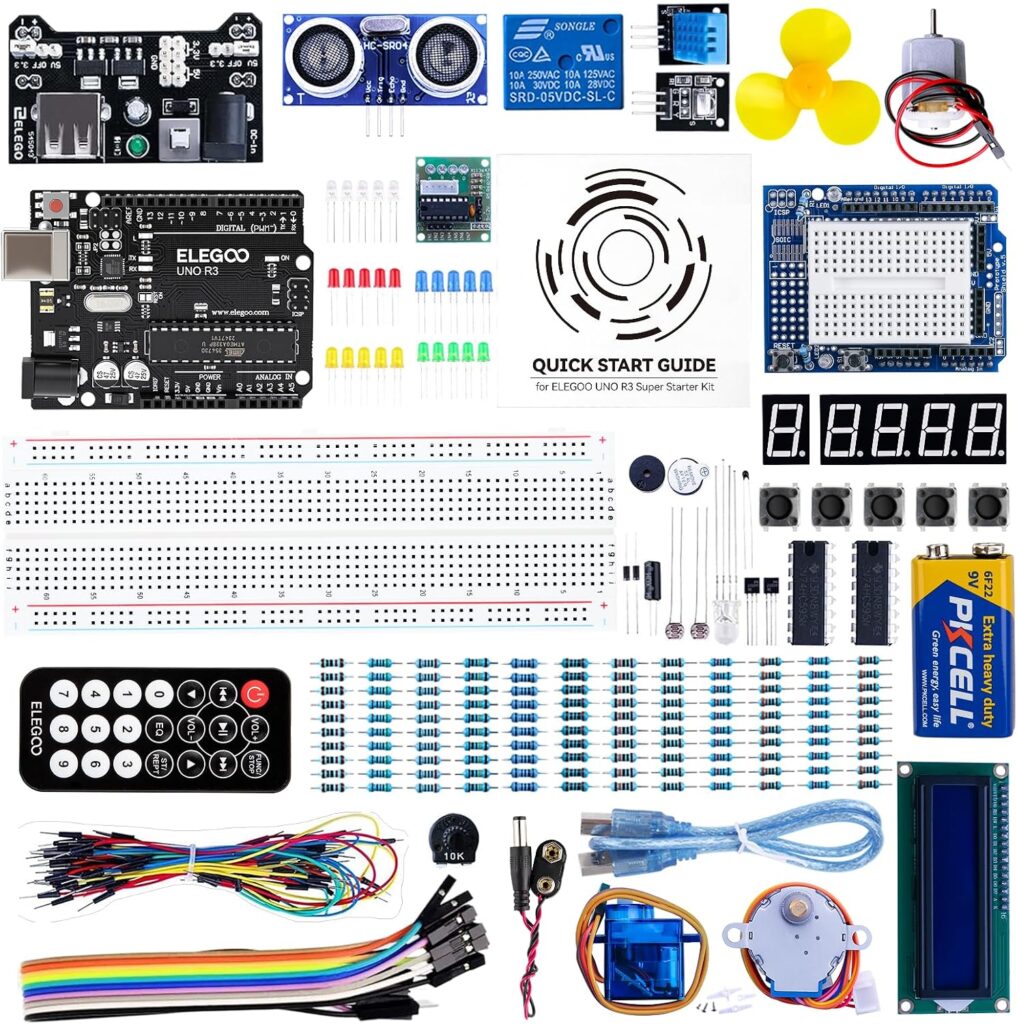
The kit arrives in a package measuring approximately 21 x 14 x 5 centimeters and weighing just over 540 grams. This is a compact, manageable box that contains a range of electronic components, sensors, wires, and the central controller board. The product listing emphasizes that the kit comes with a clear listing of its contents in a neat package, which is a practical detail for those who are just starting out and need to identify each part as they work through lessons.
At the heart of the kit is the UNO R3 controller board. This board is described as high-quality and is compatible with Arduino. This compatibility is a central theme of the ELEGOO brand, which states that its kits are 100% compatible with Arduino. For a beginner, this means the board should work with the standard Arduino development environment and follow the familiar UNO form factor and pin layout, making it easier to find tutorials and support online.
Design and Build Quality
The physical design of the kit is oriented toward ease of use. One of the most notable features for newcomers is the inclusion of an LCD1602 module that comes with a pin header already attached. This is a small but significant detail. Many display modules require the user to solder the header pins onto the board before they can be used in a breadboard circuit. The fact that this module does not require self-soldering removes a potential barrier for absolute beginners who may not yet own a soldering iron or have developed that skill. It allows the user to focus on the core concepts of wiring and coding rather than on assembly.
Beyond the display, the kit is described as an upgraded version because it includes a power supply module and a 9V battery with a DC connector. Power management is often a stumbling block in electronics projects, so having a dedicated power module and a battery included in the box means the user can get projects running without needing to source additional power adapters separately. The listing notes that the kit requires 2 CR2 batteries, which are included. This attention to providing the necessary power accessories suggests that the kit is intended to be functional right out of the box.
Features and Learning Resources
The educational component of this kit is one of its strongest attributes. It includes a free PDF tutorial that contains more than 22 lessons. These lessons are designed to guide the user through the process of learning electronics and programming in a structured way. For a beginner, having a curated path from simple to more complex projects is far more effective than trying to piece together information from disparate online sources. The tutorial is meant to walk users through the basics, likely starting with simple LED circuits and gradually introducing sensors and more complex components.
The kit is positioned as an ideal and cost-effective choice for beginners who want to get started with open-source electronic programming. The term “open-source” is key here, as it refers to the ecosystem of hardware designs and software libraries that are freely available for modification and sharing. This kit is designed to be a gateway into that ecosystem. The inclusion of various sensors and components allows for the creation of a wide range of introductory projects, from simple blinking lights to more interactive builds that respond to environmental inputs.
Performance and Everyday Experience
While it is not possible to measure the performance of the board without hands-on testing, the product information provides some clear indications of its intended functionality. The board is stated to be of high quality, and the brand emphasizes its strong R&D team and its commitment to constantly upgrading and improving its products. This suggests a focus on reliability and refinement, though it is a company claim rather than an independent finding.
In terms of the everyday experience, the practical implications of the kit’s design are clear. The pre-soldered LCD module saves time and frustration. The inclusion of the power supply module and 9V battery means that one of the most common hurdles—providing stable power to a project—is addressed from the start. The organized packaging helps users keep track of small components like resistors, LEDs, and jumper wires, which are easy to lose. The step-by-step PDF tutorial provides a roadmap, which is invaluable for maintaining momentum and motivation when learning a new technical skill.
The kit’s focus is on getting started. It is not positioned as a professional development tool or a platform for advanced industrial prototyping. Instead, it is a learning instrument. The components are chosen to teach fundamental concepts like digital input and output, analog reading, and interfacing with common sensors and displays. The goal is to build a foundation of knowledge that can later be applied to more complex, custom projects.
Compatibility and Ecosystem
The most important compatibility detail is the board’s stated compatibility with Arduino. This is a significant advantage for a beginner. The Arduino ecosystem is vast, with a massive amount of code libraries, tutorials, and community support available online. By using a board that is compatible with this standard, the user can leverage this existing knowledge base. If they get stuck on a lesson or want to try a project that is not in the included tutorial, they can search for solutions using standard Arduino terminology and find help.
This compatibility also extends to the physical hardware. The UNO R3 form factor is a standard in the maker community. This means that the many expansion boards, or “shields,” that are designed for the Arduino UNO should, in principle, be compatible with this ELEGOO board. While the kit itself contains a variety of sensors and components, the ability to expand with additional hardware in the future adds to the long-term value of the kit as a starting point.
Who Is This Product Best For?
Based on the supplied information, this kit is explicitly designed for beginners. It is described as a best-practice solution for those who do not have the appropriate technical tools or knowledge to learn about electronics. The target audience is clearly the student, hobbyist, or curious individual who wants to learn programming and electronics from the ground up.
It is particularly well-suited for someone who prefers a structured learning approach. The 22-plus lessons in the PDF tutorial provide a clear curriculum, which is helpful for self-learners who might otherwise feel lost. The kit is also a good fit for parents or educators looking for a comprehensive educational tool for young people. The brand states that its mission is to make STEM education easy to learn and accessible to the younger generation, indicating that the kit is designed with a younger audience in mind, though the content is suitable for any age.
This kit is not aimed at experienced engineers or makers who already have a collection of components. For them, a bare controller board would be more appropriate. The value here is in the curation and the educational support. It is for the person who is ready to move beyond theory and start building actual circuits and writing real code but needs a helping hand to get there.
Final Verdict
The ELEGOO UNO R3 Super Starter Kit presents a complete and thoughtful package for anyone taking their first steps into the world of electronics and programming. Its key strengths lie in its focus on the beginner experience: a compatible UNO R3 board, a display module that does not require soldering, a power supply module with a battery included, and a structured PDF tutorial with over 22 lessons. The kit is designed to be a cost-effective and practical entry point into the open-source electronics ecosystem, removing many of the initial hurdles that can frustrate newcomers. While it is not a tool for advanced users, it serves its stated purpose well as a comprehensive educational starter kit for those ready to begin their journey.