

ELEGOO Electronic Fun Kit Bundle with Breadboard, 235 Items for Arduino
Electronics learning has a way of stalling before it starts. The reason is rarely a lack of curiosity. More often, it comes down to not having the right parts on hand when an idea takes shape. A single missing resistor or jumper wire can end a session before it begins. The ELEGOO Electronic Fun Kit Bundle with Breadboard, 235 Items for Arduino is built around that problem. It gathers a broad spread of common components into one package so that beginners and hobbyists can spend their time building rather than hunting for parts.
This is a component kit rather than a finished gadget. It does not produce a single outcome on its own. Instead, it supplies the raw materials for breadboard circuits and mini projects, and it expects the user to bring a compatible microcontroller and a willingness to follow wiring guidance. Understanding what is and is not in the box is the key to judging whether it fits your plans.
What Comes in the Kit
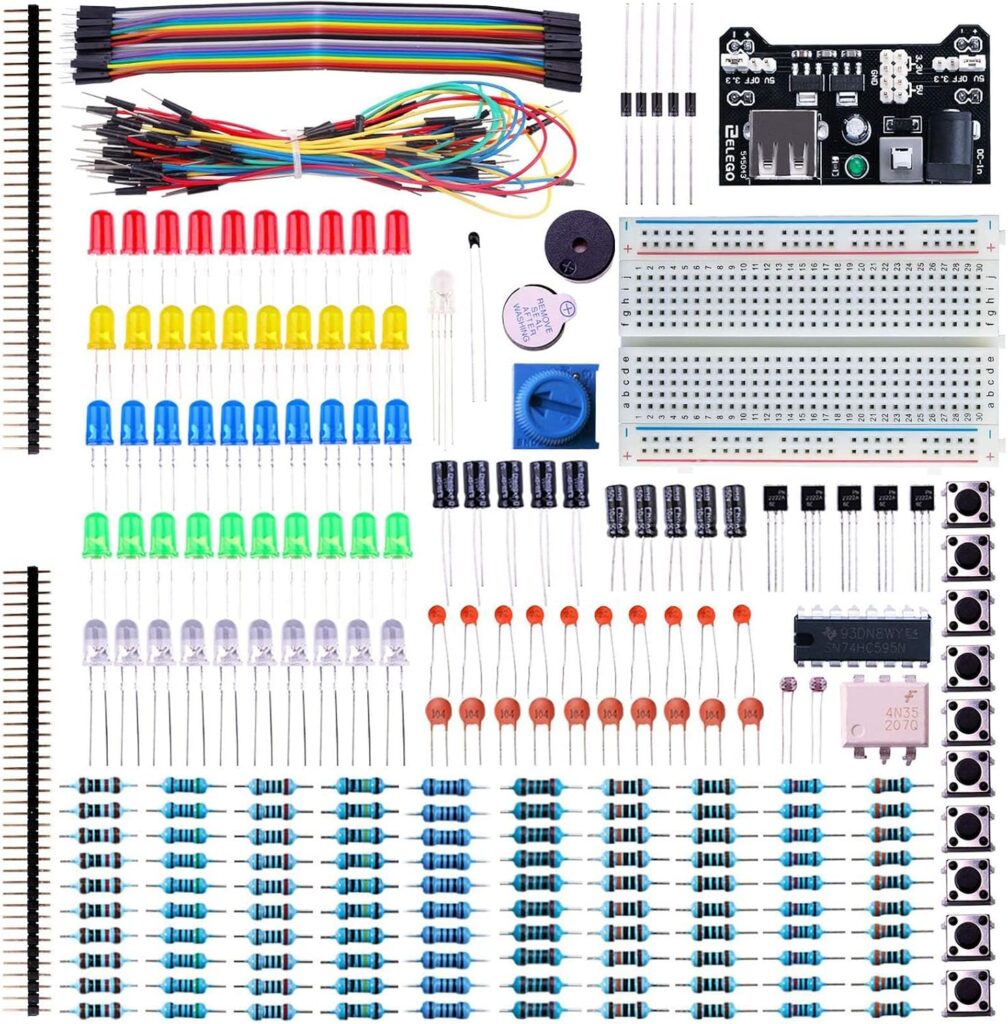
The headline figure is 235 items, and the contents lean toward the parts that show up again and again in introductory electronics work. At the center is a 400-tie-point solderless breadboard, which allows circuits to be assembled and taken apart without soldering. That single feature shapes how the kit is used: components can be repositioned, swapped, and reused across repeated experiments rather than committed to a permanent build.
Supporting the breadboard are jumper wires and Dupont wires, including rigid jumpers and female-to-male leads. These are the connections that turn a pile of parts into a working circuit. A breadboard power module is also included, providing selectable 3.3 V or 5 V rails. That choice of voltage rails matters because different components and microcontrollers operate at different logic levels, and having both options available on the board simplifies matching a circuit to the hardware driving it.
The passive and active component selection covers the essentials: a potentiometer, buttons, LEDs, resistors, capacitors, diodes, transistors, buzzers, and light-sensitive components. For anyone working through the early stages of electronics, this is a familiar and practical mix. It supports input devices, output devices, and the components that sit between them.
Design and Build Considerations
Solderless breadboarding is the organizing principle here, and the kit is designed around it. The rigid jumpers and female-to-male leads are intended to simplify connections, which is a practical detail when a circuit grows beyond a few parts. Loose, flimsy wiring can make troubleshooting harder than the circuit itself, so having leads suited to the task is a genuine convenience.
Power delivery deserves attention. The breadboard power module accepts a suitable 6.5–9 V DC input, and the guidance is explicit: do not exceed 9 V. That upper limit is worth respecting. Users should also note that a wall power adapter is not included, so the power source is something to plan for separately.
The kit’s dimensions are listed at roughly 14.48 x 8.99 x 3.99 cm with a weight of about 180 g, which suggests a compact package that stores easily between sessions. Country of origin is listed as China, and the manufacturer is ELEGOO.
Features and Learning Value
What separates a component kit from a random assortment is whether the parts teach something. This kit includes several components that introduce concepts beyond simple on-and-off circuits. The 74HC595 shift register allows outputs to be expanded, which is a useful lesson in how a limited number of microcontroller pins can control more devices. The 4N35 optocoupler offers a way to explore signal isolation. PN2222 transistors can be used to switch loads, and 1N4007 diodes support polarity protection and rectification experiments.
Those parts give the kit a progression. A beginner can start with LEDs and buttons, then move toward circuits that involve signal handling and load switching. The listed project ideas reflect that range: LED indicators, button inputs, traffic-light sequences, light-activated circuits, RGB effects, and buzzer alarms. These are classic exercises for electronics practice, classroom demonstrations, and maker projects, and they map naturally onto the components provided.
ELEGOO positions its STEM kits as a way to make electronics and programming more accessible, and the company notes that its kits are 100% compatible with Arduino. The brand also states that it maintains an R&D team focused on upgrading products, along with an after-sales support team. Those are manufacturer claims rather than independently verified facts, but they indicate the intended audience: learners who want a supported starting point.
What Is Not Included
This is where expectations matter most. A controller board, programming cable, and wall power adapter are not part of the bundle. For coded projects, a compatible microcontroller must be supplied separately. That is not a flaw so much as a design decision, but it does mean the kit is not a standalone, open-the-box-and-go solution.
Users should also plan to follow the current tutorial, datasheets, and wiring guidance. Component kits of this kind depend on accurate references, and the documentation that accompanies a given version of the kit is the appropriate source for pinouts and circuit details. Because kit contents can vary between versions, it is worth confirming the exact parts list for the specific bundle before relying on any single component being present.
Who Is This Kit Best For?
The clearest fit is the beginner who has no established set of technical tools for learning electronics. The combination of a breadboard, a broad component selection, and dual-voltage power rails supports the trial-and-error approach that early learning requires. Students working through classroom demonstrations or self-directed study will find the project types listed here align with typical coursework.
It also suits makers who want a stocked supply of common parts for prototyping. Having resistors, capacitors, transistors, and LEDs on hand reduces interruptions, and the solderless breadboard makes quick testing practical. Anyone who already owns a compatible microcontroller and is looking to expand their parts inventory is a natural candidate.
It is less suited to someone expecting a complete, self-contained project. Without a controller board, programming cable, or power adapter, the kit requires additional purchases before coded work can begin. Those who want a single box that delivers a finished device should look elsewhere.
Final Verdict
The ELEGOO Electronic Fun Kit Bundle is a thoughtfully assembled collection of components for breadboard-based learning. Its strengths are breadth and reusability: 235 items spanning the parts most beginners actually need, a 400-tie-point solderless breadboard that encourages repeated experimentation, and a power module offering both 3.3 V and 5 V rails. The inclusion of the 74HC595, 4N35, PN2222, and 1N4007 adds conceptual depth beyond basic circuits.
Its limitations are equally clear and clearly stated. No controller board, programming cable, or wall adapter is included, and the power input must stay within the 6.5–9 V range. Buyers should treat this as a component supply rather than a complete starter package. For learners and hobbyists who already have or plan to get a compatible microcontroller, it offers a practical foundation for building, testing, and rebuilding circuits as skills develop.